If you followed a diagram, went looking for the spot it promised, and came away wondering what you did wrong, here is a thought. Maybe the instructions are the problem, not you.
Plenty of guides describe the G-spot like it is a settled fact. The anatomy research is not nearly that confident.
Some people love pressure along the front wall of the vagina. Others feel almost nothing there, would rather stay external, or have zero interest in going internal. That whole range is normal.
Researchers have never pinned down a distinct G-spot structure that sits in the same place and does the same thing in everyone. That leaves a lot of room for pleasure, and no reason to treat this like a test you can fail.
A better place to start is the clitoris. Its full structure and nerve supply explain a great deal. Anatomy can show you what is possible. Your own body tells you what you actually like.
What the term G-spot actually describes
Most of the time, the term points to a supposedly sensitive patch on the front wall of the vagina, the side that faces your bladder and pubic bone. In casual talk it can mean two different things: a spot that feels good, or a specific structure someone claims causes that feeling. Those are not the same claim, and they need different proof.
You can describe a sensation without knowing which tissue caused it. Proving a separate structure exists is a much bigger ask. It takes repeatable results from dissection, imaging or microscopes. Feeling pleasure in an area does not, by itself, prove that it contains a separate organ.
A 2021 systematic review looked at 31 studies that used questionnaires, exams, imaging and anatomical methods. The findings clashed. When researchers did report a G-spot, they disagreed on where it was, how big it was and what it was made of. Studies of nerve distribution in the vagina could not consistently find one spot with a richer nerve supply either.
That uncertainty should change how guides talk. It does not erase anyone's pleasure. It just makes a universal find this exact point instruction hard to defend.
The clitoris extends beneath the surface
The little external nub most people call the clitoris is only the glans. It usually sits partly under the clitoral hood. The organ keeps going inside, through a body and a pair of crura, which you say KROO-ruh. One crus is one of the two long roots of erectile tissue that attach along the pubic arch. Crura are tissue, not exposed nerve endings you can find with a finger.
The vestibular bulbs are paired erectile structures that sit right beside the vaginal opening and are closely tied to the clitoris. Terminology varies on whether the bulbs count as part of the clitoris or sit alongside it. Either way, the bulbs and the crura are different structures and deserve their own labels on a diagram.
In MRI research with ten healthy volunteers, Helen O'Connell and John DeLancey mapped how close the clitoral structures, the urethra and the vagina sit to each other. That work shows why a flat external drawing only tells part of the story. These structures sit at different depths inside a very compact area.
A note on the figure: it shows internal and external structures together just for orientation. Shapes, distances and depth are simplified. It is not a cross-section, and it is not a map for finding a G-spot. The nerve pathway in the diagram is conceptual.
The takeaway is proximity. Several structures sit close together, so the spot you touch and the tissue behind a sensation do not have to be the same thing. For a fuller look at the external and internal picture, see Joybloom's clitoral anatomy guide.
How the internal structures relate to nerves
The dorsal nerve of the clitoris, a branch of the pudendal nerve, is a key route for clitoral sensation. In a study of 14 adult cadaver specimens, researchers traced it running beside the crura, along the clitoral body and into the glans, where the ends fanned out. The point here is simple. A nerve runs alongside tissue and supplies it. A crus is not a nerve, and it is not a hidden switch.
Clitoral function also involves autonomic nerves tied to erectile response. Sensation and tissue swelling run on interacting systems, and the dorsal nerve is one piece of that. No nerve diagram can tell you which pressure, rhythm or spot you will like.
Other genital areas have sensory routes too. In a small functional MRI study, clitoral, vaginal and cervical stimulation lit up neighbouring but distinguishable patterns in the sensory cortex. Brain imaging does not prove a G-spot exists, and it does not rank one kind of orgasm above another. It just makes clear that reducing everything to a single point or pathway misses the point.
Why front-wall pressure can still feel good
The urethra, the front vaginal wall, the clitoral structures and the tissue around them all sit close together. Researchers have floated the term clitourethrovaginal complex to describe how they relate and possibly interact. That is a way to think about several structures as a group. It is not a universally agreed new name for the G-spot.
A 2014 anatomical review looked at this broader area and how the structures might interact during stimulation. It offers one explanation for why pressure in one place could involve tissue nearby. It does not prove that every pleasant vaginal sensation comes from the clitoral crura, or that one internal technique will work for everyone.
Direct dissection has pushed back too. In a 2017 study of 13 cadavers, researchers did not find a discrete G-spot in the spot where it is usually said to be. That study only looked at a small set of specimens, and it could not measure what living people feel.
Put together, this supports careful wording. This region can feel good for some people is useful. Everyone has a button here and enough effort will switch it on asks more than the evidence can give.
External pleasure needs no qualification
Many old guides treat external stimulation as a warm-up for a more advanced internal act. The evidence gives no reason to line pleasure up that way.
In a US probability survey of 1,055 women aged 18 to 94, 18.4% said intercourse alone was enough to reach orgasm. Another 36.6% said clitoral stimulation was necessary to orgasm during intercourse, and 36% said it improved their orgasms even when it was not strictly needed. People also reported very different tastes in touch location, pressure, shape and rhythm.
These are self-reported experiences from one population, not a rulebook for every person with a vulva. Their real value is that they show how much variation exists. Liking external touch, needing it during penetration, or preferring it on its own all fit inside that range.
You can enjoy internal pressure and external touch together, pick one, or pick neither. There is no anatomical rule that says you have to move from one to the other. An experience that feels good already tells you something worth keeping.
When curiosity turns into performance monitoring
Have I found it yet can turn into a running loop in your head. You start clocking the time, comparing yourself to a partner's expectations, or checking whether your reaction looks convincing enough. Now exploration has an audience, even when you are alone.
Research links this kind of distraction to sexual experience, though the relationship is tangled. A 2021 study of 1,619 women found that a negative genital self-image was tied to self-critical distraction during sex and to lower reported pleasure and function. The study was observational, so it does not prove that G-spot expectations cause anxiety, or that changing your thoughts will fix a sexual problem.
What it does offer is a reason to make room for attention without grading yourself. If you catch yourself mentally keeping score, come back to a simpler question. Do I want this touch to keep going? The answer might be yes, or less pressure, or somewhere else, or stop. Every one of those is useful.
Trouble relaxing is not another failure to fix. Pain, past experiences, relationship stuff and other concerns may need more support than an anatomy lesson can give.
A gentler way to explore
If you want to experiment, make it an experience with choices, not a search with a deadline. These suggestions are options, not a treatment plan or a promise of orgasm.
- Choose one small question. Maybe ask whether broader external contact feels better than focused contact, or whether you prefer stillness to movement. One question is easier to learn from than trying to copy a whole technique.
- Start where you are comfortable. External touch is a complete option on its own. Going internal is optional, and you can decide against it before or during. Clean hands, smooth nails and a good lubricant help cut avoidable friction if you do choose it.
- Change one thing at a time. Adjust the spot, the pressure or the rhythm, then notice how you respond. Changing all three at once makes it hard to tell what you actually like. You can go back to something familiar instead of pushing to find the next thing.
- Use plain words. Comfortable, too intense, neutral, nice, or I would rather stop are all enough. You do not need to name a structure or produce a dramatic reaction. Feeling neutral can just mean you would prefer something else today.
- Let it end. There is no minimum time and no discovery you owe yourself before stopping. You might finish knowing a certain approach is just not interesting to you. That is a clearer result than pressing on because a diagram said it should work.
Give a partner feedback they can use
A partner can care about your pleasure and still carry a very confident idea of what your body should do. It helps to talk about expectations away from the moment itself, when neither person is waiting for a particular response.
Something like this works. I would like us to explore without trying to prove we can find a G-spot. I will tell you what feels good and what I want to change. If I prefer external touch or want to stop, please go with that.
In the moment, short cues like keep that pressure, a little lighter or let us pause give clearer info than a location borrowed from a guide. Both people are allowed to change their minds. If bringing a device into the conversation is on the table, our guide to talking about a sex toy with a partner is a good place to start.
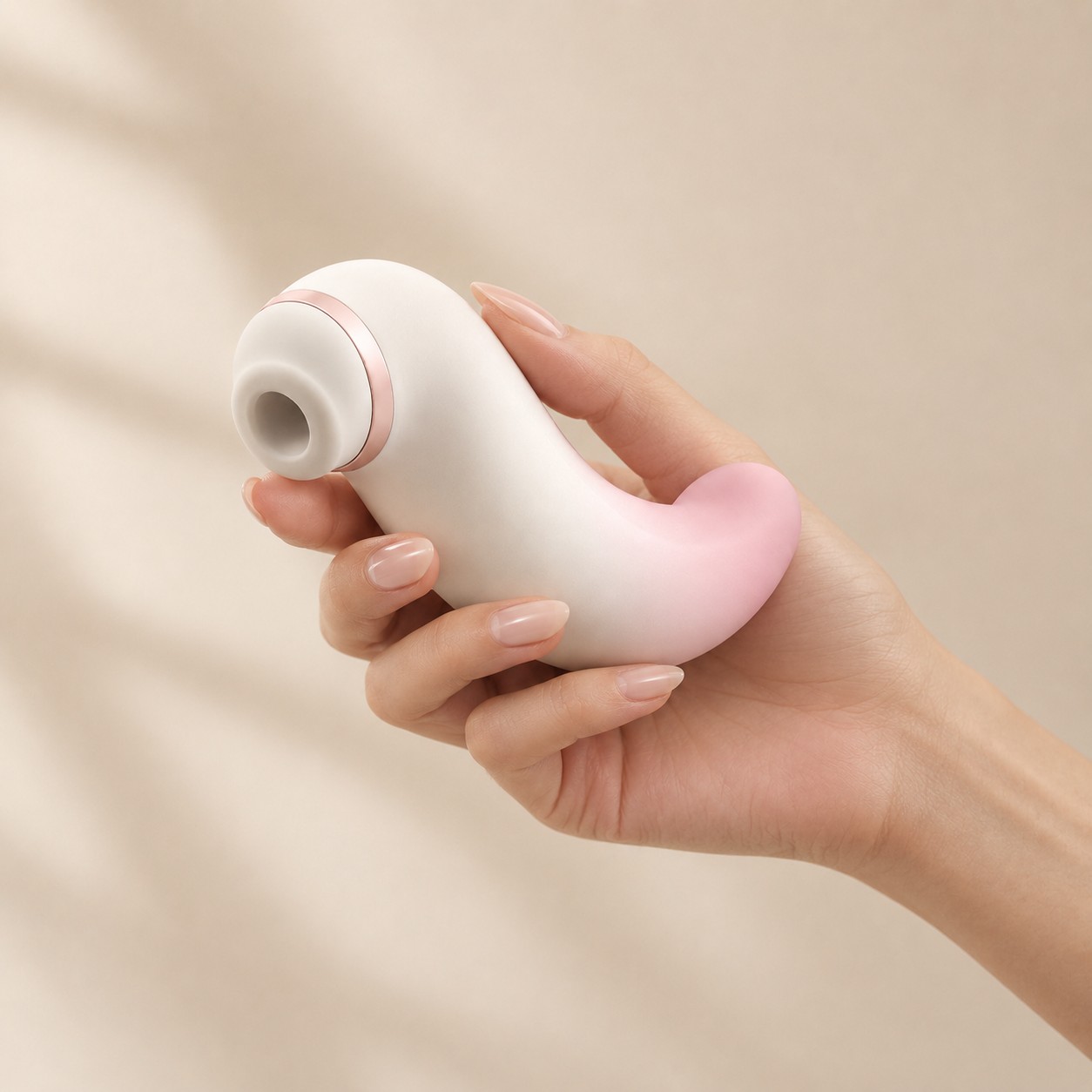
Product labels deserve the same scrutiny as diagrams. G-spot vibrator usually describes a design's intended use. It cannot confirm you have a distinct G-spot, guarantee a good fit, or make an internal orgasm a requirement. Pick a shape and controls that fit an experience you actually want. Buying anything is optional.
When discomfort needs attention
Stop if exploring causes pain, burning, bleeding or numbness. Pain is not a sign that you are getting close to the right spot. Get qualified medical advice for symptoms that keep coming back or stick around. NHS guidance on vulval pain recommends assessment when pain keeps returning or makes touch or penetration hard. Unexplained bleeding should be checked too.
You can also ask for support for ongoing distress even without pain. A qualified sexual-health clinician or therapist can help you talk through worries about sensation, orgasm or performance. You do not need to show up with a diagnosis already worked out.
Anatomy gives you language for understanding your body. Let it open up more choices: good external touch, curious internal exploration, a pause, or a conversation. Your own response gets to decide which of those belongs in your experience.